Showing posts with label People-Behavior Issues. Show all posts

Thursday, September 25, 2025

Operational Excellence - The Concept - The Practice


New

Breaking operational barriers to peak productivity
October 4, 2024 

The world needs more productivity growth. As a recent McKinsey Global Institute report  argues, it’s the best possible antidote to wealth inequality, inflation, and exploding debt and could provide crucial funding for the net-zero transition and improved living standards.

Over the past few years, three primary vectors of operational improvement have promised to raise productivity, but companies have often struggled to take full advantage of the potential:

The technologies collectively referred to as 4IR (or Industry 4.0) can improve performance across an entire value chain. But McKinsey research indicates that only 30 percent of organizations successfully scale and sustain digital improvement.

In 2023, research from McKinsey Digital estimated that gen AI could add $2.6 trillion to $4.4 trillion to the global economy. But by 2024, only about 5 percent of organizations said they could attribute at least 5 percent of their EBIT to gen AI.

Core operational excellence practices have a proven track record of creating significant improvement across variables ranging from cost reduction to employee retention—with the effects increasing over time. But data from the Operational Excellence Survey (OES) indicate that few organizations perform well across all five elements (Exhibit 3). Those that do are far more likely to sustain impact from 4IR and gen AI: operational excellence increases the value that technologies can generate.


Pic. Source.  https://www.linkedin.com/feed/update/urn:li:activity:7255912402729234432/


Excellence is Exceeding Customer Expectations.


Operational Excellence,  is a broader methodology that aims to improve the overall performance of an organization by aligning all aspects of the business with the company's vision and strategy. 

It emphasizes the importance of leadership, culture, and employee engagement to create and drive a culture of excellence and continuous improvement . Operational Excellence function can use all tools or techniques. Its  aim is to bring the entire organization together to strive for excellence.

https://www.reliableplant.com/operational-excellence-31886

https://instituteopex.org/what-is-operational-excellence/

https://www.ibm.com/cloud/blog/delivering-value-through-operational-excellence

https://www.forbes.com/sites/forbestechcouncil/2022/12/20/understanding-operational-excellence-and-the-continuous-optimization-of-it-operational-efficiency/

Excellence is Exceeding Customer Expectations.


Consultants


Operational excellence looks beyond cost reduction and process improvements towards the achievement of long-term sustainable growth. It is a mindset that embraces certain principles and tools to create a culture of excellence within an organization. Operational excellence means every employee can see, deliver and improve the flow of value to a customer.


Operational Excellence
Business Improvement
The focus of Operational Excellence is a hybrid of cost containment, operational throughput and a stable work force. The objective is a management team who are equipped to operationalise business strategy, implement change in their organisation’s processes and systems, and maximise value over the life of the asset.

Deloitte’s Operational Excellence offerings assist Operational Executives to operationalise business strategy, implement improvement and change in their organisation’s processes, systems and people, as well as to maximise the value over the life of an asset or organisation.  Operational Excellence includes:

- Environmental scanning & Strategic Context
- People, Performance and Culture
- Process Optimisation
- Supply Chain and Sourcing
- Asset Care
- Asset and Resource Optimisation
- Continuous Improvement
- Management Control Systems
- Organisational Redesign and Simplification
- System Capacity and Capability
- Social Labour Plan Commitments

Process Improvement Management - Process Productivity Management for Operational/Process Excellence - 3.6% Cost Reduction per Year


Companies

https://www.jpmorganchase.com/about/our-business/operational-excellence


27.10.2024


Sergio D'Amico, CSSBB  

I talk about continuous improvement and organizational excellence to help small business owners create a workplace culture of profitability and growth.
26.10.2024


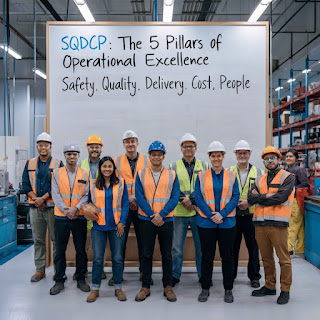
Operational Excellence is  a system.0f 5 Pillars.

Here’s how the SQDCP five pillars can change your operations:

1️⃣ 𝗦𝗮𝗳𝗲𝘁𝘆:
- Unsafe conditions derail productivity and add costs.
- Focus on building a safe workspace, and watch efficiency rise.

2️⃣ 𝗤𝘂𝗮𝗹𝗶𝘁𝘆:
- Quality doesn’t cost; poor quality does.
- Set high standards and fix issues at the source.

3️⃣ 𝗗𝗲𝗹𝗶𝘃𝗲𝗿𝘆:
- Late delivery kills trust.
- Meet deadlines consistently to build client confidence.

4️⃣ 𝗖𝗼𝘀𝘁:
- Cost control isn’t about cutting, it's about using resources wisely. (Productivity of Resources - Industrial Engineering)
- Streamline processes to reduce waste, not quality.

5️⃣ 𝗣𝗲𝗼𝗽𝗹𝗲:
- People drive change; machines don’t.
- Train, motivate, and listen to your team. They’re the backbone of excellence.

Comment by Jim Beckham
Retired Director, Total Quality Management at JTEKT Corporation


I find the comments on priority an interesting discussion point. Let me contribute from someone who worked 14 years at one of the Toyota group of companies. We only used the first four, in priority sequence, SQDC. But it’s important to understand which stakeholder is impacted by each:
Safety- Employee stakeholder;
Quality - Customer stakeholder;
Delivery - Customer stakeholder; and
Cost - Shareholder stakeholder.

When management, an improvement team or a QC Circle follows the 8-Step Problem Solving method to make an improvement to one of these four areas, the solution for the improvement can not adversely impact the areas above. For example it a team was trying to improve productivity (Cost) and the improvement would make it more dangerous for the workers, or create a quality defect, or impact delivery, then the team would have to find another solution.


Additional Comment by Jim Beckham, Retired Director, Total Quality Management at JTEKT Corporation


Just to be clear, an improvement could be made that adversely impacts an area below and that would ok. For example, when fixing a Quality problem the solution can’t adversely impact Safety (which is above), but it could adversely impact Cost or Delivery (which are below). This is ok. It then gives the improvement team motivation to then solve the secondary Cost or Delivery problem. A little pain is always a good motivator for teams to take ownership and to improve.


Ud. 25.1.2025, 27.10.2024

Pub.  26.1.2023


Saturday, June 6, 2020

Behavioral Approaches/Actions for Productivity Improvement - R.A. Sutermeister


The Actions suggested have to form part of Productivity Management

People Productivity Factors and Action to Use Them to Increase Productivity - Model by R.A. Sutermeister


1. Productivity

The need for productivity and ways to increase productivity are to be discussed with employees and unions (participation and efforts to persuade).

2. Technological Development
         Raw Materials
         Job Layout
         Methods

There has to be information exchange and discussion with employees and union about the technological changes and opportunity for the organization to make use of them. Give opportunity for employees and union to make suggestions regarding their adoption.

3. Employees' Job Performance

Discuss with each employee his job performance and help him to improve it.

4. Ability

           5. Knowledge
               Education
               Experience
               Training
               Interest
           6. Skill
           7. Motivation

Select employees after assessment based on their abilities which can be fully utilized in the organization and whose needs can potentially be met under the conditions existing in the firm. In behavioral context, the psychological and social conditions in existing in the firm.


8. Physical Conditions
               Lighting
               Temperature
               Ventilation
               Rest Periods
               Safety
               Music

Decent physical conditions are required for productivity. Suitermeister is present sociology aspect of productivity. He does not give any special focus for physical conditions.


9. Individual Needs - Physiological, Social, Egoistic

Management has to make special effort to discover the real needs of the employees.

                10. On the Job - Off Job Activities
                       Perception of the situation
                       Level of Aspiration
                       Reference Group
                       Male - Female
                       Cultural Background
                       Education
                       Experience
  11, Situation at a Point in Time
                       General Economic Conditions
                       Individual's Personal Situation

Employees' needs change over time due change in environment. Hence discovering needs of employees needs to be done periodically.


             12. Social Conditions
                   13. Formal Organization
                         14. Organization Structure
                         15. Leadership Climate
                         16. Organization Efficiency
                         17, Personnel Policies
                         18. Communication
                         19. Specific Environment of Company or Plant

                   20. Informal Organization (Groups)
                         21. Size
                         22. Cohesiveness
                         23. Groups

                   24. Leaders


                   33. Union


From R.A. Sutermeister,  People and Productivity, McGraw Hill, New York, 1969

Thursday, July 27, 2017

Prohibition Policy in Bihar


There is an editorial in today's Economic Times (27 July 2017)  http://blogs.economictimes.indiatimes.com/et-editorials/90300/

Editorial in 27 July 2017 TheEconomic Times

BJP the gainer, as Nitish Kumar recalibrates
July 26, 2017, 11:42 PM IST ET Edit in ET Editorials | India, politics | ET

The last sentence

In all this, Kumar has demonstrated that he is one of India’s most ruthless — and flexible — politicians. We would urge Kumar to show similar flexibility and scrap, or at the very least partially reverse, his prohibition policy, which can only be enforced by using the coercive power of the state and a concomitant violation of civil liberties.

Should Nitish Kumar scrap prohibition policy as suggested by the Editor of Economic Times?


After prohibition, Bihar aims for dowry-free villages

Political analysts believe that after successfully imposing prohibition on liquor in Bihar, chief minister Nitish Kumar is now raising the bar in an attempt to emerge as a social reformer.
Updated: Jul 16, 2017
Reena Sopam, Hindustan Times, Patna
http://www.hindustantimes.com/india-news/after-prohibition-bihar-aims-to-have-dowry-free-villages-to-rope-in-mukhiyas-religious-leaders-in-campaign/story-StjGXRGNjrnGNsZ9c7KFuL.html


Prohibition in Bihar: Supreme Court extends deadline for liquor disposal till 31 July
29 May
http://www.firstpost.com/india/prohibition-in-bihar-supreme-court-extends-deadline-for-liquor-disposal-till-31-july-3493679.html


Why prohibition has worked in Bihar?

D. N. Sahaya | New Delhi
April 28, 2017
The writer is ex-Governor, Chattisgarh and Tripura and former chairman, A. N. Sinha Institute of Social Studies, Patna.
http://www.thestatesman.com/opinion/why-prohibition-has-worked-in-bihar-1493329920.html

Tough Implementation of Prohibition in Bihar

The Bihar model of prohibition seems to have taken off with a bang, with around 44,000 people put behind bars and over 10 lakh litres of liquor seized, during its one-year of enforcement since April 1, 2016.
1 April 2017
http://www.dnaindia.com/india/report-bihar-walks-a-tough-line-in-first-year-of-total-prohibition-2377348

Somebody is unhappy that media is not writing against prohibition and its strict implementation.
Bihar’s liquor war: Prisoners of prohibition and the conspiracy of silence
By opinionbihar March 9, 2017
http://www.opindia.com/2017/03/bihars-liquor-war-prisoners-of-prohibition-and-the-conspiracy-of-silence/

PM asks people of Bihar to support the prohibition policy

PATNA, JANUARY 05, 2017
http://www.thehindu.com/news/national/Modi-says-cheers-to-Nitish%E2%80%99s-liquor-ban/article16992313.ece

PM Modi praises Nitish Kumar for ‘remarkable ability’ over prohibition policy in Bihar
Prime Minister Narendra Modi on Thursday praised Bihar chief minister Nitish Kumar over his controversial move to ban liquor in the state despite objections from all quarters, calling it a “courageous step”.
Jan 05, 2017
HT Correspondent
Hindustan Times, Patna
http://www.hindustantimes.com/india-news/pm-narendra-modi-praises-nitish-kumar-for-his-prohibition-policy-in-bihar/story-2EFiHIYKYGCkXD8JW0rU0K.html


PM urged to put ban on sale of alcohol across the country.

Bihar CM, while addressing his recent anti-liquor campaigns in different states especially Uttar Pradesh and Jharkhand, urged the PM to put ban on sale of alcohol across the country.
A former governor of Assam and Tamil Nadu, Bhishma Narain Singh, who hails from BJP-ruled Jharkhand, supported Nitish Kumar and requested the Prime Minister Narendra Modi to announce complete ban on alcohol and tobacco across the country on the occasion of International Yoga Day on June 21.
Jun 20, 2016
http://timesofindia.indiatimes.com/india/Nitish-Kumar-asks-Narendra-Modi-to-ban-alcohol-across-country/articleshow/52838603.cms


The Bihar Prohibition And Excise Act, 2016
http://nyaaya.in/law/858/the-bihar-prohibition-and-excise-act-2016/


National consensus on prohibition sought
Dec 25, 2001
Chennai: Ambedkar People's Movement (APM) president and former Chennai mayor Vai Balasundaram on tuesday appealed to the centre and state governments to evolve a national consensus on implementation of prohibition in the country.
http://timesofindia.indiatimes.com/city/National-consensus-on-prohibition-sought/articleshow/1035208499.cms?

Saturday, November 23, 2013

Behavioral Aspects of Industrial Engineering


Occasionally, ideas occur which appear to possess advantages to the originator other than those which can be measured in dollars and cents. In presenting suggestions of this nature, advantages and disadvantages should be presented in tabulated form, so that a decision can be quickly made.

Ideas of this kind are more subject to rejection than those which show definite money savings. Perhaps the advantages to be gained are so largely theoretical that a busy man is not able to visualize them, or perhaps the cost of making the change seems to outweigh the intangible benefits that are expected. If a suggestion of this type is rejected after proper presentation, the suggester should drop it and cease to worry about it. Fretting about unadopted ideas occupies the mind when it should be engaged in originating new suggestions and often causes dissatisfaction and reduces efficiency.

The rejection of an idea does not mean that it possesses no merit. It merely indicates that the benefits it offered did not appear to the one who made the decision to be sufficiently important to warrant expending the effort necessary to get them. The decision is made in the light of such factors as present trends, the future business outlook, and the amount of money available for making improvements. In 6 months or a year, the situation may have changed, and the idea may be welcomed and adopted upon re-presentation. If the idea is presented the second time by another individual, the one who first presented it has a natural tendency to feel discouraged. He must ward off this feeling by recognizing that conditions change and that fresh angles of presentation often lead to the adoption of old ideas. The best antidote against discouragement is to go out and discover another idea. Solving problems and originating suggestions bring satisfaction to the type of men who are in supervisory positions and help to make the daily job more interesting.

(Source:  Chapter 2 - Operation Analysis by Maynard)


Updated 22 August 2017, 23 November 2013